
Most conversations about how to increase beauty brand consumption start in the wrong place.
Founders ask:
how do we acquire more consumers?
Investors ask: what does the CAC to LTV ratio look like?
Operators ask: how do we drive beauty brand repeat purchase?
The right question is earlier than all of them: how often does the consumer face the problem your product solves?
That is Frequency. The F in the FCUK framework (Frequency, Consequence, Urgency, Knife). The single lever that determines the natural speed of your loyalty loop, the structural ceiling on your customer lifetime value, and the organic acquisition potential built into your product architecture.
Get Frequency right and beauty brand consumption compounds on its own. Get it wrong and you are spending to re-acquire consumers who simply forgot you existed – the most expensive failure mode in beauty brand unit economics.
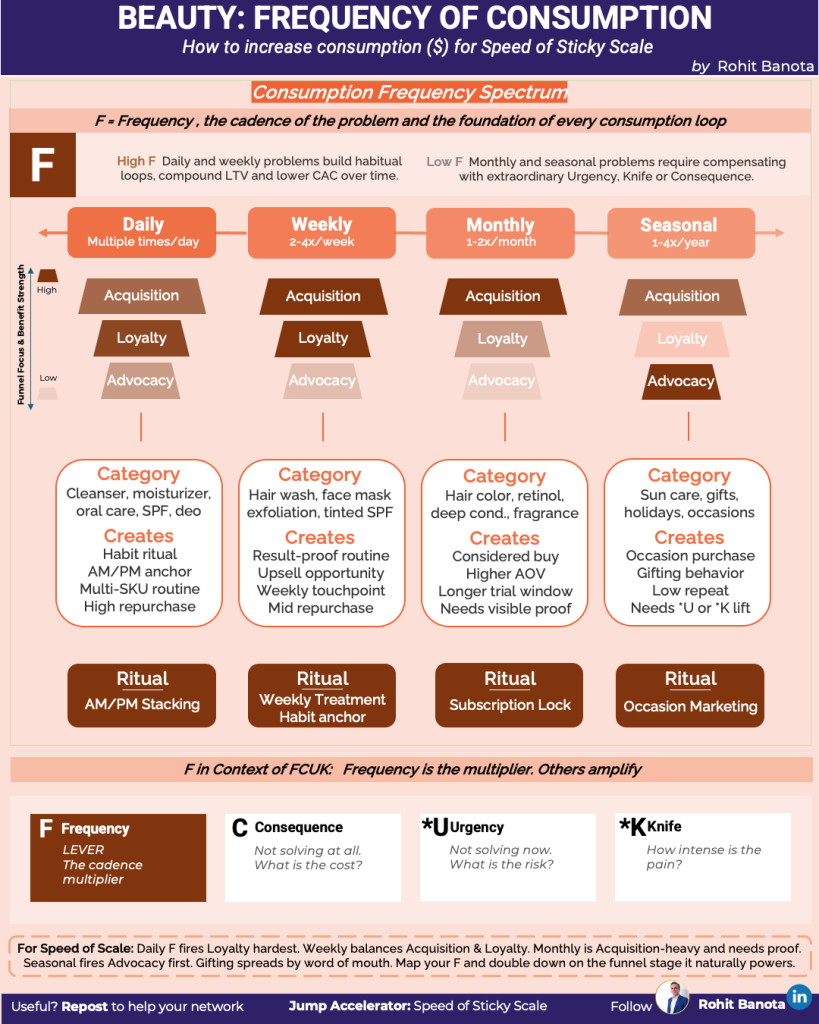
The Consumption Frequency Spectrum
F = Frequency, the cadence of the problem and the foundation of every consumption loop.
Two structural truths that govern the entire framework:
- High F (Daily and Weekly): Problems at this cadence build habitual consumption loops. They compound LTV naturally, lower effective CAC over time, and generate organic advocacy as a byproduct of consistent use. Loyalty fires first. Acquisition follows. This is the beauty brand loyalty flywheel in its most powerful form.
- Low F (Monthly and Seasonal): Problems at this cadence are considered, infrequent but highly salient purchases. The brand cannot rely on habit formation. It has to compensate with extraordinary Urgency (U), Knife (K), or Consequence (C) to drive equivalent trial velocity.
Which Funnel Stage Fires Hardest at Each Frequency Tier?
This is the core insight. Each frequency tier in the consumption frequency spectrum puts different structural weight on the three funnel stages: Acquisition, Loyalty, and Advocacy.
| Frequency Tier | Acquisition | Loyalty | Advocacy |
|---|---|---|---|
| Daily | Secondary | Primary | Weak/opportunity |
| Weekly | Primary | Primary | Weak/opportunity |
| Monthly | Primary | Secondary | Weak |
| Seasonal | Secondary | Weak | Primary |
This is not a ranking. It is a diagnostic. Every tier can build a scalable indie beauty brand. The question is: are you doubling down on the funnel stage your F naturally powers, or are you fighting it?
Ritual Strategy Per Tier
Ritual engineering is the mechanism that locks Frequency into habitual behaviour:
- Daily: AM/PM stacking, multi-step skincare routine product stack strategy. Own the morning and the night.
- Weekly: Named occasion, weekly treatment anchor. Wash Day. Mask Sunday.
- Monthly: Subscription lock, monthly replenishment ritual. Beauty subscription strategy as a Frequency tool, not a retention gimmick.
- Seasonal: Occasion marketing, gifting program. Engineer the gifting reason before you engineer the product.
F in Context of FCUK
F does not operate alone. It is the multiplier inside the FCUK problem attraction framework for how to increase beauty brand consumption:
- F (Frequency): The cadence lever. The multiplier.
- C (Consequence): What is the cost of not solving this problem at all?
- U (Urgency): What is the risk of not solving it now?
- K (Knife): How intense and unbearable is the pain?
Low-F beauty brands must compensate hard on C, U, and K. High-F brands have a structural CAC and LTV advantage because the problem reminds the consumer every single day, without any marketing spend.
Daily Frequency: The Loyalty Flywheel
Cadence: Multiple times per day.
The consumer faces the problem every morning and every night. The problem does not wait. This is the highest-value frequency tier for beauty brand loyalty and LTV compounding. It is also where habitual consumption beauty brand architecture is most powerful.
What Daily Frequency Creates
- Habitual consumption embedded in daily life
- AM/PM anchoring across multiple SKUs in the same beauty routine
- Natural multi-step routine expansion: each daily touchpoint deepens the next
- High repurchase rate as the default outcome, not the aspiration
- Compounding beauty brand LTV: every additional daily touchpoint raises the cost of switching
Funnel Dynamics
- Primary: Loyalty. The product earns its place through repetition and visible results. This is the beauty brand loyalty flywheel operating at full speed.
- Secondary: Acquisition. The daily salience for trials is very high.
- Opportunity: Advocacy. Daily consumers could be the most credible advocates and the volume of opportunity for advocacy is the highest. Using something twice a day for 60 days creates a whole lot opportunity for a recommendation, social proof no paid campaign can replicate.
- Ritual Strategy: AM/PM Stacking. Own the morning step, own the evening step, build the bridge. Every step you own in the daily beauty routine marketing stack is a step a competitor cannot occupy.
Beauty Categories at Daily Frequency
- Cleanser, moisturiser, SPF
- Oral care, deodorant
- Daily toner, serum, eye cream
- Vitamin C, retinol (daily format)
Brand Example: Glow Recipe
Glow Recipe’s product architecture reflects exactly what high daily Frequency produces for beauty brand growth strategy: a full routine ecosystem where every product reinforces the next, compounding habit formation and cart size simultaneously.
The brand is one of Sephora’s top five brands.
Its US client base grew 97% from 2023 to 2024, according to Glow Recipe’s own reporting to WWD (May 2025).
The product stack
- Watermelon Glow PHA+BHA Pore-Tight Toner: explicitly recommended for daily AM and PM use
- Watermelon Glow Niacinamide Dew Drops: daily serum step
- Plum Plump Hyaluronic Cream: daily moisturiser, AM and PM
- Watermelon Glow AHA Night Treatment: nightly treatment step
- Avocado Ceramide Moisture Barrier Cleanser: daily double-cleanse step
- Watermelon Glow Dew Shield SPF 30: morning final step
- The full AM routine (Cleanser, Toner, Dew Drops, Moisturiser, SPF) and PM routine (Cleanser, Toner, Dew Drops, Night Treatment, Moisturiser) are explicitly mapped on their site under “Your AM Routine” and “Routine 101”
What the Frequency structure produces (observable outcomes):
- Each product reinforces the next step, creating a skincare routine product stack strategy that is harder to abandon partially than to maintain fully
- Daily touchpoints generate visible, incremental results within weeks. Visible results produce emotional lock-in. Lock-in produces unprompted advocacy.
- TikTok “morning routine” content became one of the brand’s strongest organic acquisition channels: daily-habit consumers naturally show their routines, and that content does acquisition work at zero marginal cost
- AM/PM architecture naturally expands cart size: a consumer who starts with the toner and serum has a logical next step already built into the routine
- Product names signal daily pleasure, not clinical duty: glow, plump, watermelon, banana. The naming makes the product feel like a morning ritual.
- Packaging is counter-worthy by design: bright, fruit-forward, meant to live on the bathroom shelf where it is seen and used every single day
The result:
- Glow Recipe has held a top 5 brand position at Sephora consistently over the last 6 months
- The brand’s US client base grew 97% year over year from 2023 to 2024
- A single hero product expanded into a full daily and nightly routine ecosystem, compounding beauty brand repurchase rate without promotional mechanics
Lessons for founders:
- If your product is used daily, you have a structural beauty brand loyalty advantage that most growth strategies underestimate
- Engineer the full AM and PM ritual: what happens before your product, during, and after
- Every additional daily touchpoint deepens repurchase rate and raises switching cost
- Morning and night routine content is acquisition content. It is the most efficient (high salience) channel a daily-cadence founder-led beauty brand can operate.
Weekly Frequency: The Balanced Flywheel
Cadence: 2 to 4 times per week.
The consumer faces the problem regularly but not automatically. Beauty brand habit formation has not yet locked in by default. Weekly frequency creates the most balanced funnel dynamic: Acquisition and Loyalty fire at near-equal strength, making it the most versatile tier for early-stage beauty brand scale.
What Weekly Frequency Creates
- Result-proof routine: visible improvement within 4 to 6 weeks, fast enough to produce credible before/after content
- Upsell opportunity: once the primary product proves results, the consumer adds complementary weekly SKUs, expanding beauty brand AOV
- Consistent weekly touchpoints: frequent enough for strong brand recall, deliberate enough to feel like a chosen ritual
- Mid repurchase rate: shorter cycle than monthly, longer consideration than daily
Funnel Dynamics
- Primary: Acquisition AND Loyalty in near-equal measure. Weekly visible improvement creates a very credible acquisition stories in beauty. Visible results build loyalty before the consumer considers alternatives.
- Secondary: Advocacy. When weekly results are dramatic (hair health, texture, scalp improvement), sharing becomes natural and drives new trial without paid acquisition spend.
- Ritual Strategy: Weekly Occasion + Habit Anchor. Give the consumer a named day and they will own the occasion and extend it culturally. This is how beauty brand ritual engineering works at the weekly tier.
Beauty Categories at Weekly Frequency
- Hair wash and deep treatment
- Face mask, peel, clay treatment
- AHA/BHA exfoliation
- Scalp treatment
- Tinted SPF as a workweek ritual
Brand Example: Ceremonia
Ceremonia’s product architecture reflects what weekly Frequency produces when a challenger beauty brand owns the occasion rather than just the product. Founded by Babba Rivera and inspired by hair wellness traditions from her Latinx heritage, the brand launched in 2020 with a single product and built its entire line around the weekly Wash Day ritual.
The product stack
- Aceite de Moska Scalp and Hair Oil: the founding product. A pre-shampoo scalp remedy used 1 to 2 times per week, applied to the scalp 10 to 15 minutes before washing. Inspired by a hair oil tradition from the Dominican Republic.
- Papaya Enzyme Pre-Shampoo Scalp Treatment: a weekly exfoliating scalp scrub, also pre-wash
- Deep Moisture Shampoo and Conditioner Duo: the wash step
- Deep Moisture Wash Ritual bundle: a curated set explicitly framed as a complete Wash Day ritual on their site
- All Ceremonia rituals, per their own site copy, start with Aceite de Moska and the Scalp Masajeador tool for a pre-shampoo massage
What the Frequency structure produces (observable outcomes):
- Wash Day is a named, anticipated weekly occasion. Ceremonia did not create it. They gave it product form and made it a conscious, repeatable ritual with commercial architecture.
- The pre-shampoo, wash, and post-wash architecture creates a natural multi-SKU occasion: the consumer buys the ritual, not just one product, expanding AOV without discounting
- Weekly timing means hair health results accumulate across 4 to 6 wash cycles, fast enough to produce shareable before/after content within two months
- Ceremonia’s Latinx cultural grounding gave the brand a built-in community and a ready-made language for beauty brand ritual engineering. “Wash Day” spread into mainstream beauty culture organically through community content.
- The brand outperformed its revenue expectations by over 50% within six months of launch, according to investor Silas Capital (May 2021 press release).
Lessons for founders:
- If your product is weekly, naming the ritual occasion is your single highest-leverage beauty brand growth strategy decision. Own the day, not just the product.
- Weekly visible results are a highly shareable proof point in beauty. Document and celebrate the 4 to 6 week transformation in content and at retail.
- Cultural occasions that already exist (Wash Day) are Frequency engineering at zero cost: the consumer already faces the problem on a specific day. Your job is to become the product for that day.
- Acquisition and Loyalty fire simultaneously at weekly cadence. Build both into your content strategy, not one at the expense of the other.
Monthly Frequency: The Proof-Led Flywheel
Cadence: 1 to 2 times per month
The purchase is deliberate. Results must be visible and credible before loyalty forms. Monthly frequency is the most Acquisition-heavy tier in the consumption frequency spectrum: the brand has to win the trial and proof battle before it earns repurchase. This is where beauty brand unit economics are most sensitive to CAC.
What Monthly Frequency Creates
- Considered purchase behaviour: the consumer researches, compares, and validates before committing
- Higher AOV per transaction: infrequent purchase occasions justify premium spend per use
- Longer trial window: the brand must wait one to three purchase cycles to prove results
- Visible ROI requirement: every use is evaluated because the occasion is rare enough to make it conscious
Funnel Dynamics
- Primary: Acquisition. Monthly cadence is Acquisition-heavy by nature. The purchase is infrequent and deliberate. Win the consideration battle first. Beauty brand CAC is highest here and must be earned back through proof.
- Secondary: Loyalty via ROI proof. If results are visible across 2 to 3 monthly cycles, loyalty is deep and sticky. Beauty brand LTV becomes highly defensible once the result is established.
- Weak Advocacy unless results are dramatically visible (hair transformation, colour change).
- Ritual Strategy: Subscription Lock + Monthly Occasion. Beauty subscription strategy at monthly cadence is Frequency engineering, not just a retention tactic. Lock the replenishment cycle automatically before the consumer re-enters the consideration phase.
Beauty Categories at Monthly Frequency
- Hair colour and root touch-up
- Retinol (results visible at monthly intervals)
- Deep conditioning and protein hair treatment
- Fragrance refill
- Scalp treatment (intensive, monthly protocol)
Brand Example: dpHUE
dpHUE’s product architecture reflects exactly what monthly Frequency produces when the purchase trigger is biological rather than behavioural. Root growth is not a cultural ritual. It happens on a fixed biological schedule, approximately every 4 to 6 weeks, making it one of the most structurally reliable monthly occasions in the beauty brand acquisition strategy playbook.
dpHUE gained +27 ranks at Ulta Beauty in Q1 2026 vs. Q4 2025.
The product stack
- Root Touch-Up Kit: permanent crème hair colour developed with salon professionals, designed to cover up to 1 inch of root growth. Includes precision applicator brush, two applications per kit, low-ammonia formula. Available in six shades.
- Root Touch-Up Kit for Resistant Grays: a higher-pigment version for coarser, more stubborn gray strands
- Color Touch-Up Spray: a quick-dry temporary root concealer for between monthly applications
- Gloss+: a semi-permanent conditioning gloss. Recommended for weekly use on their site to maintain colour between monthly touch-ups.
- Apple Cider Vinegar Hair Rinse: a scalp-balancing rinse that supports colour-treated hair between monthly colour occasions
- Cool Blonde Shampoo and Conditioner: daily maintenance for colour-treated hair
What the Frequency structure produces (observable outcomes):
- Root growth is a biologically fixed monthly occasion. dpHUE does not create the purchase trigger. The consumer’s biology does. The brand’s job is to be the obvious solution when that trigger fires.
- The precision brush applicator addresses the primary trial barrier to monthly DIY colour: fear of making a mess or an error. Remove the trial barrier and beauty brand customer acquisition cost drops structurally.
- The kit includes two applications per purchase, making the per-use economics more attractive and aligning naturally with subscription auto-replenishment mechanics
- The product stack ladders from monthly (colour) to weekly (Gloss+) to daily (shampoo, conditioner): each tier keeps the brand in the consumer’s hands between monthly occasions, compressing the Frequency gap and improving beauty brand repurchase rate
- Auto-replenishment subscription mechanics tied to the biological root growth cycle convert a deliberate monthly purchase into automatic replenishment, lowering effective CAC over time
Lessons for founders:
- Monthly frequency is Acquisition-first. Prove the result visibly before expecting loyalty but you need to win the consideration stage for acquisition. Beauty brand unit economics at monthly cadence live or die on proof.
- Beauty subscription strategy at monthly cadence is Frequency engineering, not just retention. Lock the replenishment cycle before the consumer re-enters consideration.
- Build companion products at higher frequency tiers (weekly, daily) to stay in the consumer’s hands between monthly occasions. The brand present every day is harder to displace on the monthly occasion.
- Monthly visible results are your highest-leverage acquisition content. Before/after mechanics should be built into the product experience from day one.
Seasonal Frequency: The Advocacy-First Flywheel
Cadence: 1 to 4 times per year.
The consumer faces the problem only at specific external occasions: a season, a holiday, a gifting moment, a special event. The purchase is low-frequency and high-intent. The brand cannot build loyalty through habit formation.
The only funnel stage it can power reliably and immediately is Advocacy. Gifting is inherently social. A seasonal product given as a gift reaches a new consumer at zero paid media cost, through a trusted personal recommendation. This is the beauty brand advocacy engine at seasonal cadence.
Seasonal cadence facilitates acquisition too as the salience for the product and category is very high but it is likely to be easier & less incremental than advocacy.
What Seasonal Frequency Creates
- Occasion purchase behaviour triggered by an external event, not a personal routine
- Gifting behaviour: seasonal products are disproportionately bought as gifts, multiplying reach without additional CAC
- Low personal repeat (once per summer, once per holiday season)
- Requires Urgency (U) or Knife (K) to drive conversion: the seasonal window is short
Funnel Dynamics
- Primary: Advocacy. The gift recipient is a new consumer acquired through a trusted personal recommendation at zero paid media cost. Gifting is the most efficient beauty brand advocacy engine available.
- Secondary: Acquisition via occasion context. The seasonal window concentrates attention on the category and justifies high-intent trial.
- Weak Loyalty from the seasonal buyer personally. Potentially strong loyalty from the gift recipient who discovers the brand for the first time at a gifting moment.
- Ritual Strategy: Occasion Marketing + Gifting Program. Beauty gifting marketing strategy is Frequency strategy. Build the gifting reason before you build the product. The product that looks and feels like a gift gets bought as one.
Beauty Categories at Seasonal Frequency
- Sun care and SPF body products (summer)
- Holiday gift sets and limited edition collections
- Fragrance (as a gift)
- Luxury bath and body (as a gifting occasion)
- Event-specific makeup (New Year, graduation, wedding season)
Brand Example: Vacation Inc.
Important note for founders: In August 2025, the FDA issued a warning letter to Vacation regarding their mousse and foam sunscreen formats over regulatory compliance. Vacation confirmed they are working with the FDA to resolve the matter. Monitor this development if referencing the Classic Whip format specifically.
Vacation’s product architecture and business results reflect what seasonal Frequency produces when a challenger beauty brand owns the emotional experience of the occasion rather than just solving the functional problem. Their beauty brand gifting strategy is the mechanic. The advocacy loop is the outcome.
The product stack
- Classic Whip SPF 30 Mousse: the hero product. A lighter-than-air whipped sunscreen with Vacation’s signature scent (coconut, banana, pool water, pool toy, swimsuit fabric), developed in partnership with ARQUISTE Parfumeur and Givaudan. Also available in SPF 50.
- Classic Lotion SPF 30: the original body sunscreen
- After Sun Lotion: post-sun care step completing the seasonal occasion stack
- Orange Gelée SPF 30: a revival of the discontinued Bain de Soleil product. Built a 15,000-person waitlist before launch. Sold out in three days.
- “Vacation” by Vacation eau de toilette: launched before the first sunscreen. A fragrance that smells like sunscreen and swimming pools. Became a permanent bestseller at Nordstrom and extended the brand into a year-round gifting occasion.
What the Frequency structure produces (observable outcomes):
- The brand gives away over 1,000 products per week to creators and event organisers, betting that photogenic packaging and a signature scent will drive word-of-mouth organic advocacy and UGC content (Inc., August 2025)
- 80% of Classic Whip sales come from TikTok Shop, driven primarily by gifting content creators on the platform. This is beauty brand advocacy engine mechanics in practice. (Glossy, April 2024)
- Vacation jumped from No. 24 to No. 13 in US sunscreen sales within a year of its Ulta launch
- The Orange Gelée revival shows Urgency and Knife levers working at seasonal cadence: a 15,000-person waitlist built through public documentation of the product recreation process, sold out in three days at launch
- Vacation’s fragrance extended the brand into year-round gifting, lifting its natural seasonal cadence to near-permanent. This is how a challenger beauty brand scales Frequency over time: by entering adjacent occasion categories at higher cadence tiers.
Lessons for founders:
- Seasonal frequency means the beauty brand advocacy engine is your primary acquisition mechanic. The product that photographs well, smells memorable, and feels like a gift will be bought as one.
- Low personal repeat does not mean low brand growth. One gifted product can generate one new consumer who repurchases independently every summer for years.
- Urgency and Knife are your compensating levers. Create the seasonal window, communicate scarcity, and give the consumer a reason to act now.
- TikTok gifting seeding is a Frequency strategy at seasonal cadence: you are engineering the advocacy moment before the consumer faces the seasonal problem themselves.
- Extending into adjacent year-round categories (fragrance, after sun) is how a seasonal challenger beauty brand lifts its Frequency tier and improves its beauty brand unit economics over time.
Applying the Framework: How to Diagnose Your Beauty Brand Growth Strategy
Use the consumption frequency spectrum as a strategic diagnostic, not a creative exercise.
Step 1: Map your product’s natural cadence
- How often does your consumer actually face the problem?
- Daily, weekly, monthly, or seasonal?
- Does your current brand positioning match the natural cadence, or are you fighting it?
Step 2: Identify which funnel stage you naturally power
- Daily: double down on Loyalty. Build the routine ecosystem. Engineer every daily step you can own in the beauty routine product stack.
- Weekly: balance Acquisition and Loyalty equally. Name the occasion. Build the visible proof cycle. This is beauty brand ritual engineering at the weekly tier.
- Monthly: lead with Acquisition. Beauty subscription strategy locks the replenishment. Build companion products at daily and weekly tiers to bridge the Frequency gap.
- Seasonal: lead with Advocacy. Engineer the gifting mechanic. Compensate hard on Urgency and Knife.
Step 3: Identify your FCUK compensating levers
If F is low (monthly or seasonal), compensate on:
- C: make the cost of not solving the problem vivid and felt
- U: create urgency within the seasonal or monthly window
- K: sharpen the pain point so the consumer cannot rationalise delay
If F is high (daily or weekly), protect and compound it:
- Beauty brand ritual engineering compounds the structural advantage
- Every additional daily touchpoint raises switching cost and deepens beauty brand LTV
- Content that shows the ritual is your most efficient acquisition channel and lowest-CAC touchpoint
Step 4: Engineer the ritual
- Daily: AM/PM protocol, multi-step beauty routine stack, counter-worthy packaging
- Weekly: named occasion, pre/during/post ritual architecture
- Monthly: subscription auto-replenishment, companion products at higher cadence tiers
- Seasonal: curated gift sets, limited edition urgency, targeted retail placement at the moment of seasonal problem intensity
The Investor and Acquirer Lens
For beauty investors and M&A teams evaluating early-stage and challenger beauty brands, Frequency is one of the clearest structural signals in a brand’s unit economics.
What high-F brands show in due diligence:
- Naturally compounding beauty brand LTV without requiring loyalty initiatives program spend
- Beauty brand repurchase rate driven by habit, not promotion
- CAC that declines over time as organic advocacy from daily or weekly users increases
- Multi-SKU routine logic in the product architecture (higher AOV without discounting)
- Habitual consumption beauty brand mechanics that are structurally defensible
What low-F brands require:
- Stronger U, K, C mechanics to drive trial and repeat
- Beauty gifting marketing strategy investment at scale
- Companion products at higher frequency tiers to bridge the Frequency gap
- Beauty subscription strategy as a Frequency engineering tool, not just a retention tactic
The acquisition signal:
The most valuable indie beauty brands in the current M&A environment share a common structural trait: they own a Frequency occasion. Ceremonia owns Wash Day at Sephora. Glow Recipe owns the daily skincare ritual. dpHUE owns root day at Ulta. Vacation owns the summer sun occasion and is actively extending into year-round gifting through fragrance. Owning the occasion is owning the purchase trigger. That is the kind of defensible beauty brand growth strategy moat that acquirers pay premiums for.
Summary
Frequency is a beauty brand growth strategy decision baked into your product architecture, storytelling & advocacy.
The cadence at which your consumer faces the problem determines:
- Which funnel stage fires hardest and where to invest your beauty brand unit economics
- Your natural CAC trajectory (high-F means compounding efficiency over time)
- How fast your beauty brand LTV grows without additional spend
- What your daily beauty routine marketing strategy and content should actually be doing
- How your product portfolio should expand to deepen routine ownership
- What your brand looks like to a strategic acquirer or beauty investor in the current M&A environment
Map your F(Frequency). Engineer the ritual.
Then let C, U, and K amplify what F already built.
JUMP ACCELERATOR
Beauty solutions for speed of sticky scale + Reports| 70+ brands grown