
Early-stage beauty brands rarely deliberate enough to improve their innovation. They build, launch, and push, then wonder why consumers aren’t trying, adopting, or advocating. The answer lives in three places: the position, strength of your problem and the advantage of your solution. My framework for rate of innovation adoption maps all three.
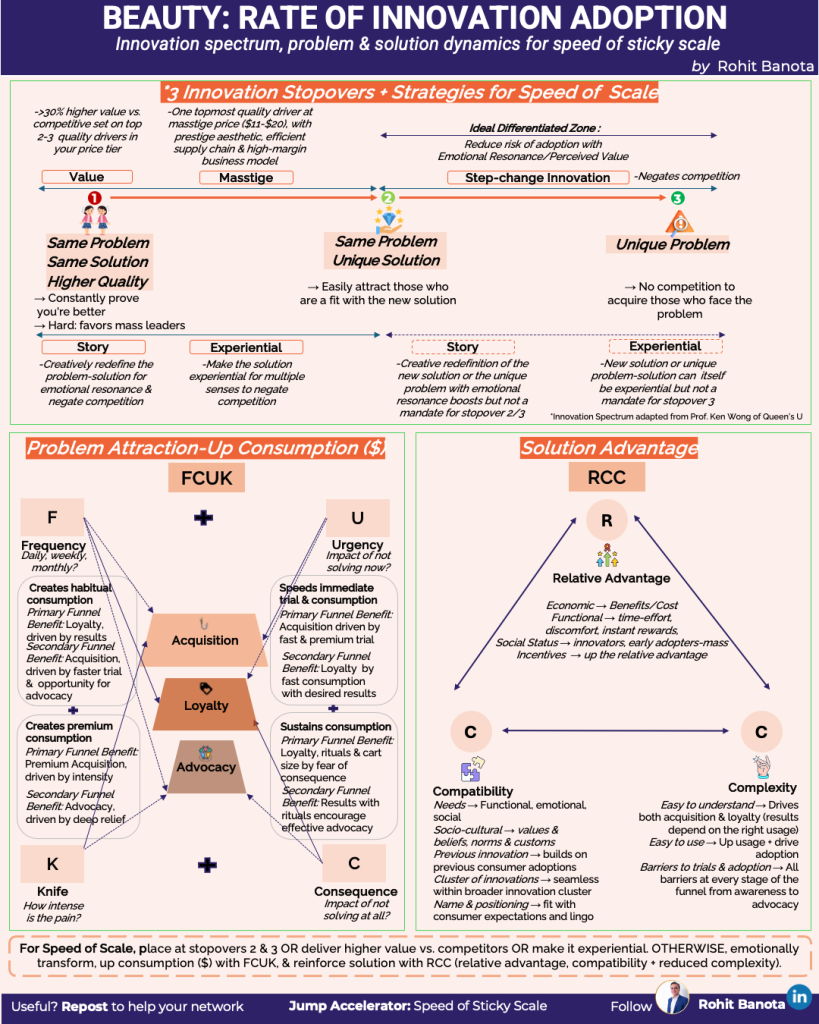
3 Innovation Stopovers + Strategies for Speed of Sticky Scale for Beauty Brands
Stopover 1
Problem-Solution Dynamic: Same Problem. Same Solution. Higher Quality.
What this means competitively
- Constantly prove you’re better
- Hard lane: structurally favors mass market leaders with R&D and distribution scale
Strategies to win
Value: 30% higher value vs. competitive set on top 2-3 quality drivers in your price tier
Masstige: One topmost quality driver at masstige price ($11-$20), with prestige aesthetic, efficient supply chain and high-margin business model (sits closest to Stopover 2)
Story: Creatively redefine the problem-solution for emotional resonance to negate competition
Experiential: Make the solution sensorial across multiple touchpoints to negate competition
Brand Example:
Value: Maybelline. Same problem (coverage, volume, finish), same solutions (mascara, foundation, liner), but relentlessly superior on 2-3 quality drivers at drugstore pricing.
- Maybelline’s edge is simple: quality that competes with prestige, priced for the mass market.
- The game is constant proof: new formulas, innovation claims, heavy ad spend to win the shelf comparison
- Hard to replicate at early stage without L’Oreal’s R&D muscle behind you. Story and Experiential are your survival levers.
Masstige: The Ordinary. Same skincare problems (aging, texture, dark spots), same ingredient solutions (retinol, niacinamide, hyaluronic acid), but a unique delivery: clinical single-ingredient formulations at radical transparency pricing with prestige positioning stripped of prestige markup.
- Removed everything the category had inflated – markup, mystique, marketing, and sold the ingredient straight.
- Sits at the edge of Stopover 1. The solution itself is not new, but the format and pricing model are different enough to attract a defined, self-selecting consumer.
- Gateway into Stopover 2 territory: the closer your Masstige play is to a genuinely unique solution, the faster you scale
Stopover 2
Problem-Solution Dynamic: Same Problem. Unique Solution.
What this means competitively
Easily attract those who are already a fit with the new solution. They self-select in. Not much convincing required.
Strategies to win
Story: Creative redefinition of the unique solution or the problem boosts adoption. Not a mandate, but a meaningful multiplier.
Experiential: Not a mandate at Stopover 2. The unique solution does the acquisition heavy lifting.
Brand Example: Topicals
Same chronic skin problems millions have always faced: eczema, hyperpigmentation, psoriasis. Unique solution: the first brand to make clinical chronic skincare culturally desirable, inclusive, and accessible without a prescription.
- When Olowe launched a brand for chronic skin conditions, the industry said consumers wouldn’t engage. Topicals sold out at Sephora in 48 hours.
- The unique solution attracted a consumer who had been completely underserved. No convincing needed.
- 675% sales growth year-over-year. The self-selection effect of a unique solution finding its exact consumer at scale.
Stopover 3
Problem-Solution Dynamic: Unique Problem.
What this means competitively
No competition to acquire those who face the problem. You are the only one who sees them.
Strategies to win
Emotional Resonance / Perceived Value: Reduce the risk of adoption. The unfamiliarity of a unique problem means the consumer needs to resonate strongly with the problem before trying the solution.
Experiential: The unique problem-solution can itself be experiential. A powerful multiplier, not a mandate.
Brand Example: Fenty Beauty
The problem Fenty named – the complete erasure of deeper skin tones from mainstream beauty – was unique, massive, and entirely unaddressed.
- Fenty launched in 2017 with nearly double the industry’s standard shade range, built specifically around the deeper tones most competitors had historically ignored.
- No competition for the consumer who faced the problem. You acquire without fighting because you are the only one who sees the person standing in front of you.
- Over $100 million in sales within 40 days of launch
- The “Fenty Effect” did not just build a brand. It forced the entire industry to restructure its product lines. That is what negating competition actually looks like.
- Rihanna’s celebrity status and her being the consumer herself gave the solution instant credibility and collapsed the barrier to first trial.
FCUK: Problem Attraction & Consumption ($)
Map your problem across four dimensions. Each activates a different part of the funnel and a different consumption behavior.
F – Frequency
How often does the problem recur? Daily, weekly, monthly?
What high Frequency creates
- Habitual consumption
- Primary Funnel Benefit: Loyalty, driven by consistent results
- Secondary Funnel Benefit: Acquisition through faster trial and organic advocacy
Brand Example: Glow Recipe
A textbook Frequency play. Glow Recipe built its entire product architecture around daily ritualized skin touchpoints: toner, serum, moisturizer, SPF, all designed for morning and night use.
- The Watermelon Glow PHA and BHA Toner is designed for morning and night use; the Watermelon AHA Sleeping Mask is gentle enough for nightly use
- Every product reinforces the next step in the routine, compounding habit formation and expanding cart size naturally
- High daily touchpoints produce visible results, which produce loyalty, which produce word-of-mouth advocacy. TikTok “morning routine” content built the brand as powerfully as any paid media.
- The Frequency lever turned a single hero product into a full routine ecosystem
The lesson: If your product is used daily, engineer the full ritual. Every additional daily touchpoint you own deepens loyalty and raises the cost of switching.No wonder, Glow Recipe has been a #5 brand at Sephora in the last 6 months.
U – Urgency
What is the impact of not solving this NOW?
What high Urgency creates
- Speeds immediate trial and consumption
- Primary Funnel Benefit: Acquisition driven by fast, often premium trial
- Secondary Funnel Benefit: Loyalty through fast consumption paired with visible results
Brand Example: Topicals (Faded Serum)
Topicals also activates the Urgency lever, particularly for hyperpigmentation consumers watching dark spots worsen in real time with every new breakout.
- The problem is visible, progressive, and worsening. Not solving it now means more spots, more discoloration, more regression.
- The Faded serum gave hyperpigmentation sufferers a clinically effective option with no prescription and no dermatologist visit required.
- Urgency collapsed the consideration window. Consumers who discovered Topicals bought immediately because waiting meant visible worsening.
- Topicals was one of the the fastest-growing skincare brand at Sephora in 2024-2025, jumping 30 spots on the retailer’s bestseller rankings within a single year & in Q1 2026, it’s in the top 10!
The lesson: If your product solves something that gets visibly worse without intervention, urgency is your fastest acquisition lever. Remove every barrier between the moment of realization and the moment of trial.
C – Consequence
What is the impact of never solving this problem at all?
What high Consequence creates
- Premium consumption driven by the cost of inaction
- Primary Funnel Benefit: Premium Acquisition driven by intensity of what is at stake
- Secondary Funnel Benefit: Advocacy driven by deep relief when the consequence is finally avoided
Brand Example: Proactiv
Acne is the ultimate Consequence category. The permanent cost of not solving it – social anxiety, identity damage, visible scarring, lost confidence during formative years – is severe enough to drive premium recurring spend.
- Celebrities in Proactiv ads described their most insecure moments as tied to their skin, wanting to hide. Not the benefit of clear skin. The cost of not having it. Consequence marketing at its sharpest.
- Lead with what is permanently lost, not what is temporarily gained.
- Proactiv turned urgency-driven first buyers into long-term subscribers through monthly replenishment, sustaining over a billion dollars in annual sales at its peak.
- Deep relief from a high-consequence problem is the most powerful advocacy trigger in the funnel. When the worst-case scenario disappears, the consumer becomes evangelical.
The lesson: The consumer who buys to avoid a bad outcome is your highest-value, most loyal customer. Show them what they are permanently avoiding, not just what they are gaining.
K – Knife
How intense is the pain? How unbearable is living with the problem?
What high Knife intensity creates
- Sustained consumption driven by fear of regression
- Primary Funnel Benefit: Loyalty, rituals and larger cart size driven by fear of immediate consequence
- Secondary Funnel Benefit: Results with rituals encourage powerful, credible advocacy
Brand Example: Pattern Beauty
Pattern Beauty was built around one of the most emotionally intense and chronically ignored pain points in beauty: coily and tight-textured hair that had spent decades being broken down by products not made for it and dismissed by a category that didn’t see it.
- Founder Tracee Ellis Ross spoke publicly about years of forcing her natural hair to conform to mainstream standards, the cumulative damage that followed, and the emotional weight of a market that had never genuinely served her. Her audience responded with thousands of shared stories. The knife was that widespread and that deep.
- Consumers with 4B and 4C textures described a lifetime of trying everything available, finding nothing that worked, and absorbing the message that their hair was simply difficult. That is not a product problem. That is identity-level pain.
- The leave-in conditioner, formulated specifically to detangle and lock in moisture for tight textures, became one of Pattern’s highest-replenishment SKUs and a significant driver of daily DTC revenue. When the solution finally matches the knife, repurchase is automatic.
- Stopping use feels like returning to the pain. Retention is built into the problem itself.
The lesson: The higher the knife, the stickier the retention. If your product solves something that genuinely hurts, physically or emotionally, you do not need to sell repurchase. Fear of regression does it for you.
Framework note: Knife (K) is the intensity of the pain itself, visceral, identity-level, unbearable. Consequence (C) is the impact of never solving it, what life looks like if the problem persists permanently. Related but distinct levers: one is felt in the moment, one looms over the future.
RCC: Solution Advantage of Beauty Brand
Having a strong problem is necessary. Not sufficient. RCC is the adoption filter. Even a great product stalls if it fails on any one of these three dimensions.
R – Relative Advantage
Why is your solution meaningfully better than what the consumer is using today?
The vectors of relative advantage
- Economic: Better benefits-to-cost ratio
- Functional: Less time, less effort, less discomfort, faster rewards
- Social Status: Signals innovator identity — early adopter, ahead of the curve
- Incentives: Tactical boosts that amplify the perceived advantage
Brand Example: Fenty Beauty
Fenty’s relative advantage landed on all three vectors simultaneously, which is why adoption was instant and viral.
- Economic: A $36 foundation that matched your skin tone was a better value than any $60 luxury product that did not
- Functional: Formulas designed for all skin types, tested in real performance conditions, with immediate visible results
- Social: Buying Fenty was an act of identity alignment. It signaled you saw what the industry had been doing and chose differently.
- Consumers from deeper skin tone communities posted emotional reactions online after finding a shade that matched them for the first time, generating organic reach no paid campaign could replicate.
The lesson: Stack your relative advantage across all three vectors if you can. One vector is a feature. Three is a movement.
C – Compatibility
Does your solution fit seamlessly into your consumer’s life, values, and existing behaviors?
The dimensions of compatibility
- Needs: Functional, emotional, social fit
- Socio-cultural: Values, beliefs, norms. Does the brand’s worldview match the consumer’s?
- Previous innovation: Does it build on what they already do and believe?
- Innovation cluster: Does it sit seamlessly within a broader category behavior?
- Name and positioning: Does it fit the lingo and expectations of the category?
Brand Example: Dove
Dove’s “Real Beauty” is the gold standard of Compatibility at a values and socio-cultural level.
- A global study commissioned by Dove revealed that the vast majority of women did not consider themselves beautiful, exposing how completely out of step the beauty industry’s messaging was with the reality of how women actually felt about themselves.
- Dove’s products became compatible with something deeper than a skincare need. They aligned with how women wanted to feel about themselves.
- The brand did not just fit the consumer’s life. It fit her worldview, her frustration, her desire to be seen accurately.
- Global sales grew from approximately $2.5 billion in 2004 to over $4 billion by 2014, Over that decade, Dove moved from being a commodity personal care product to a brand with genuine cultural standing, built entirely on a values position rather than a product claim.
The lesson: Compatibility is the most underestimated RCC lever for early-stage brands. If your brand’s worldview matches your consumer’s worldview, adoption stops feeling like a purchase decision and starts feeling like a statement.
C – Complexity
Does your consumer understand it, use it correctly, and encounter zero friction at every stage?
The dimensions of complexity
- Easy to understand: Drives both acquisition and loyalty. Results depend on correct usage.
- Easy to use: Increases usage frequency and drives adoption up the funnel
- Barriers to trial and adoption: Exist at every stage – awareness, consideration, first purchase, repeat, advocacy – and must be systematically eliminated
Brand Example: Glossier
Glossier won on Complexity reduction from day one. In a category flooded with 12-step routines, ingredient anxiety, and intimidating counters, Glossier made beauty feel approachable.
- A tightly edited lineup of hero products, each solving one simple need, created a reliable repurchase base. In-store, the experience reinforced the same philosophy: a quick, guided routine with no intimidation and no overwhelm.
- Easy to understand, easy to use, easy to buy. Every friction point between a new consumer and her first purchase was deliberately removed.
- Low complexity drove acquisition first (low barrier to trial), then loyalty (routine-building from a small, curated kit)
- Between 2015 and 2016, Glossier grew 600% year over year, not by outspending competitors but by out-simplifying them
The lesson: Complexity kills adoption silently. A consumer who does not understand your product will not buy it. A consumer who cannot use it correctly will not come back. Audit every barrier from first impression to first repurchase.
Summary
For Speed of Sticky Scale:
Place at Stopovers 2 and 3, where your unique solution or unique problem does the acquisition work. Or deliver genuinely higher value at your price tier via Value or Masstige for Stopover 1 Or make your solution experiential enough to negate comparison.
Then:
- Map your problem through FCUK to up consumption ($) Frequency, Urgency, Consequence, Knife. Activate the levers that fit your category.
- Reinforce your solution’s right to win through RCC: maximize Relative Advantage, lock in Compatibility with your consumer’s values & needs, strip every layer of Complexity from awareness to advocacy.
Speed of sticky scale is not luck. It is architecture.
JUMP ACCELERATOR
Beauty reports & solutions for speed of sticky scale| 70+ brands grown