
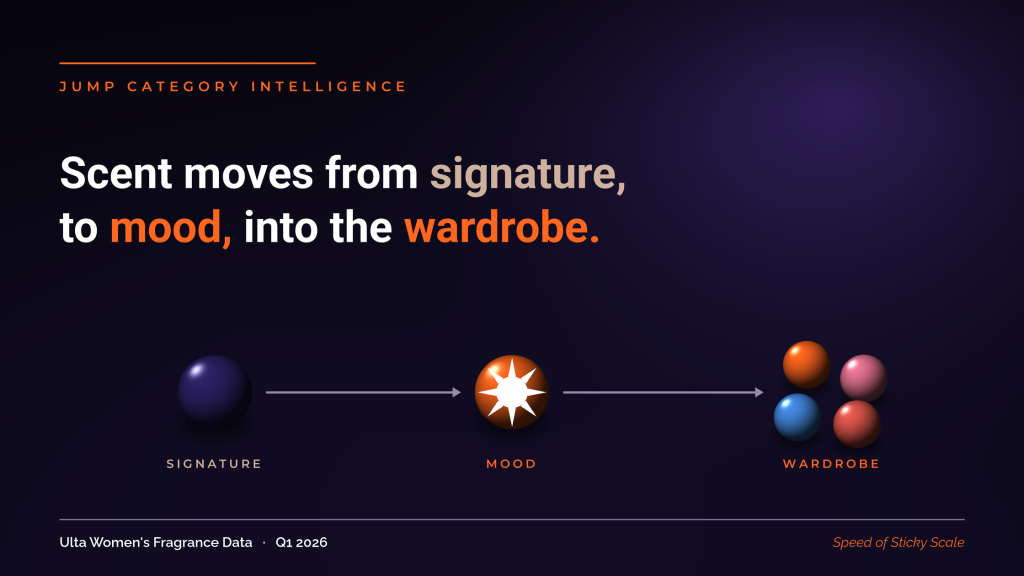
Women’s fragrance has stopped being one signature scent. It is now a fragrance wardrobe, a rotating set of scents chosen by mood, moment, and occasion.
Ulta Women’s Fragrance data from Q1 2026 shows the move in one direction: signature, to mood, into the wardrobe. Here is the full category read, and the playbook for brands that want to win it.
Signature, to mood, into the wardrobe
The category used to run on identity. One bottle, one person, for years. That logic is breaking.
Scent now moves through three stages.
Signature was the fixed identity.
Mood is the new driver, scent chosen for how she wants to feel right now.
Wardrobe is the outcome, a collection she rotates the way she rotates clothes. The shopper no longer asks “what is my scent.” She asks “what is the scent for this moment.” That single change is the engine behind the category’s growth.
Mood in action: from story to advocacy
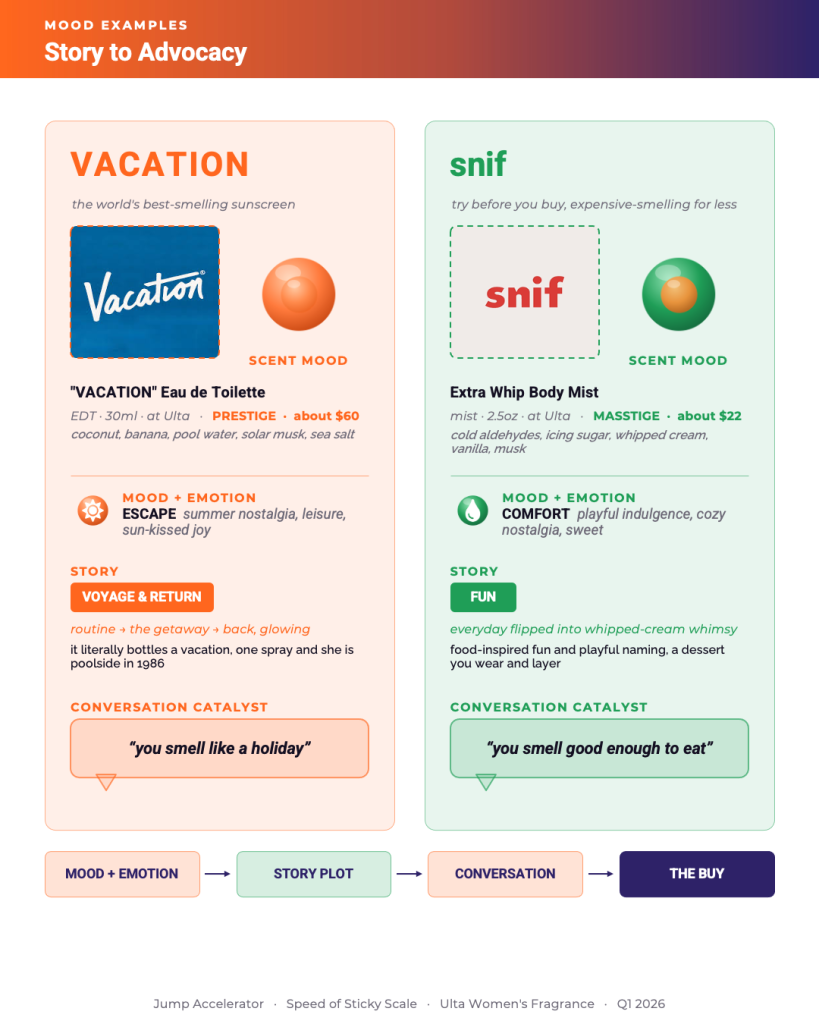
Mood is not an abstraction. It runs a clean four-step path: mood and emotion, into story plot, into conversation, into the buy.
Two brands at opposite price tiers run the same engine.
Vacation (“the world’s best-smelling sunscreen”) is a roughly $60 prestige EDT. Notes of coconut, banana, pool water, solar musk, sea salt. The mood is escape, summer nostalgia, sun-kissed joy. The story plot is voyage and return: routine, the getaway, back glowing. The conversation catalyst is the line someone says when they smell it: “you smell like a holiday.”
snif Extra Whip Body Mist is a roughly $22 masstige mist. Cold aldehydes, icing sugar, whipped cream, vanilla, musk. The mood is comfort, playful indulgence, cozy nostalgia. The story plot is fun: everyday flipped into whipped-cream whimsy. The catalyst line: “you smell good enough to eat.”
Different price, different shopper, identical machine. Emotion sets the story, the story sets the conversation, the conversation drives the buy.
The thesis: scent is now a mood, not a signature
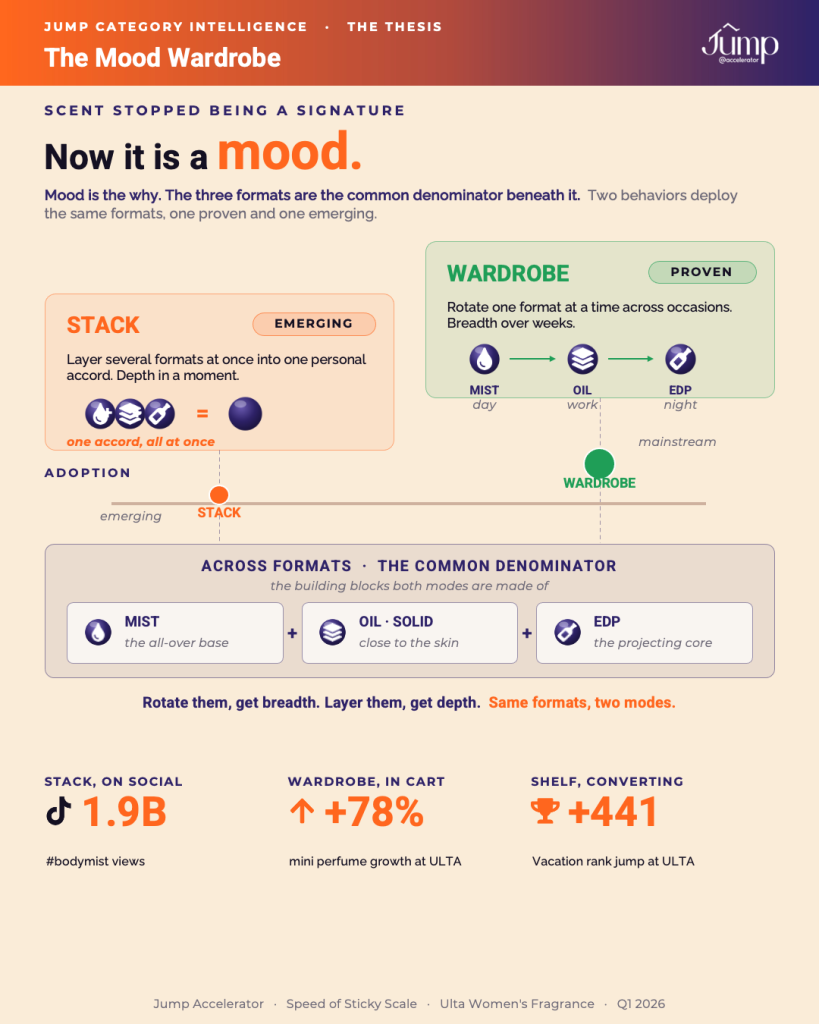
Mood is the why. Beneath it sit three formats, the common denominator of the whole category:
- Mist: the all-over base, low commitment, the social-first format
- Oil or solid: close to the skin, intimate, layerable
- EDP: the projecting core, the statement
Two behaviors deploy those same three formats:
- Wardrobe (proven): rotate one format at a time across occasions. Mist by day, oil at work, EDP at night. Breadth over weeks.
- Stack (emerging): layer several formats at once into one personal accord. Depth in a single moment. One accord, all at once.
Rotate them, get breadth. Layer them, get depth. Same formats, two modes.
The proof is in the numbers: 1.9B+ #bodymist views on social (Tik Tok), +78% growth in mini perfume at Ulta, and a +441 rank jump for Vacation mist at Ulta.
The virtuous cycle: mood kickstarts it, the lab restarts it, story explodes it
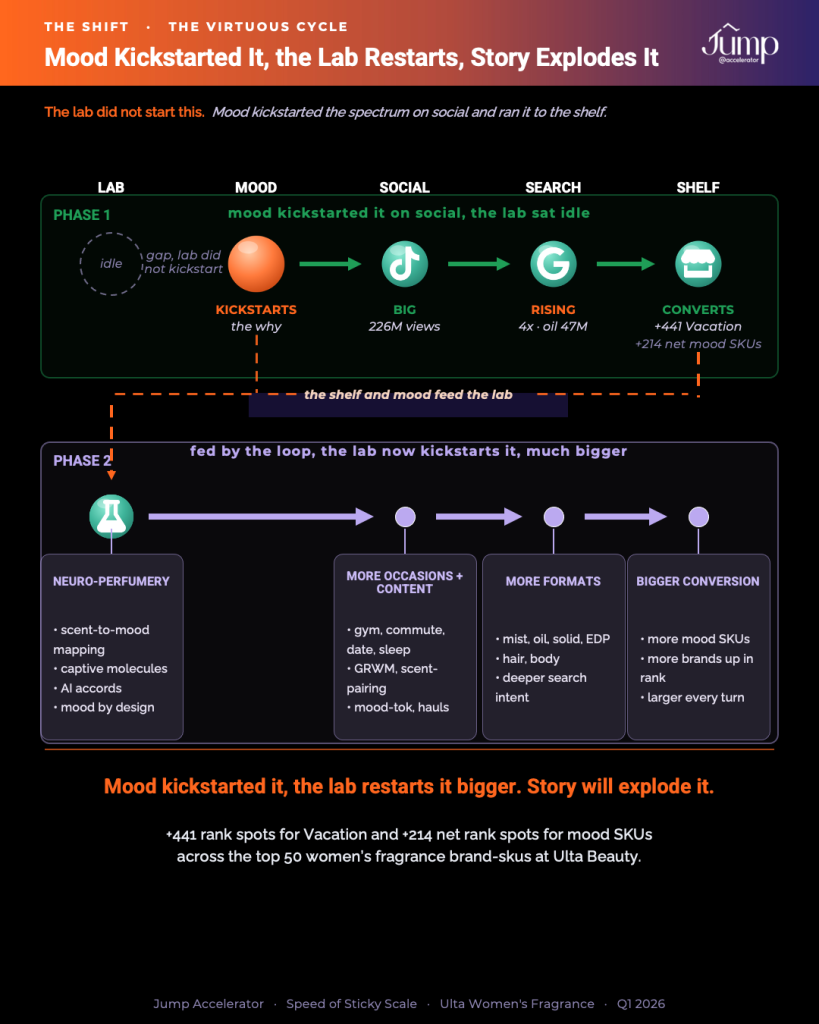
The lab did not start this. Mood kickstarted the spectrum on social and ran it to the shelf.
Phase one: the lab sat idle. Mood kickstarted demand, social amplified it (226M views for mood-tok), search picked it up (oil intent up 4x, 47M), and the shelf converted it (+441 Vacation, +214 net mood SKUs across the top 50 women’s fragrance brand-SKUs at Ulta Beauty). The shelf and the mood then fed the lab.
Phase two: fed by that loop, the lab now restarts the category, much bigger, through neuro-perfumery: scent-to-mood mapping, captive molecules, AI-built accords, mood by design. That unlocks more occasions and content (gym, commute, date, sleep, scent-pairing, mood-tok), more formats (mist, oil, solid, EDP across hair and body), and bigger conversion every turn.
Mood kickstarted it. The lab restarts it bigger. Story will explode it.
The innovation spectrum: heritage vs. the mood wardrobe
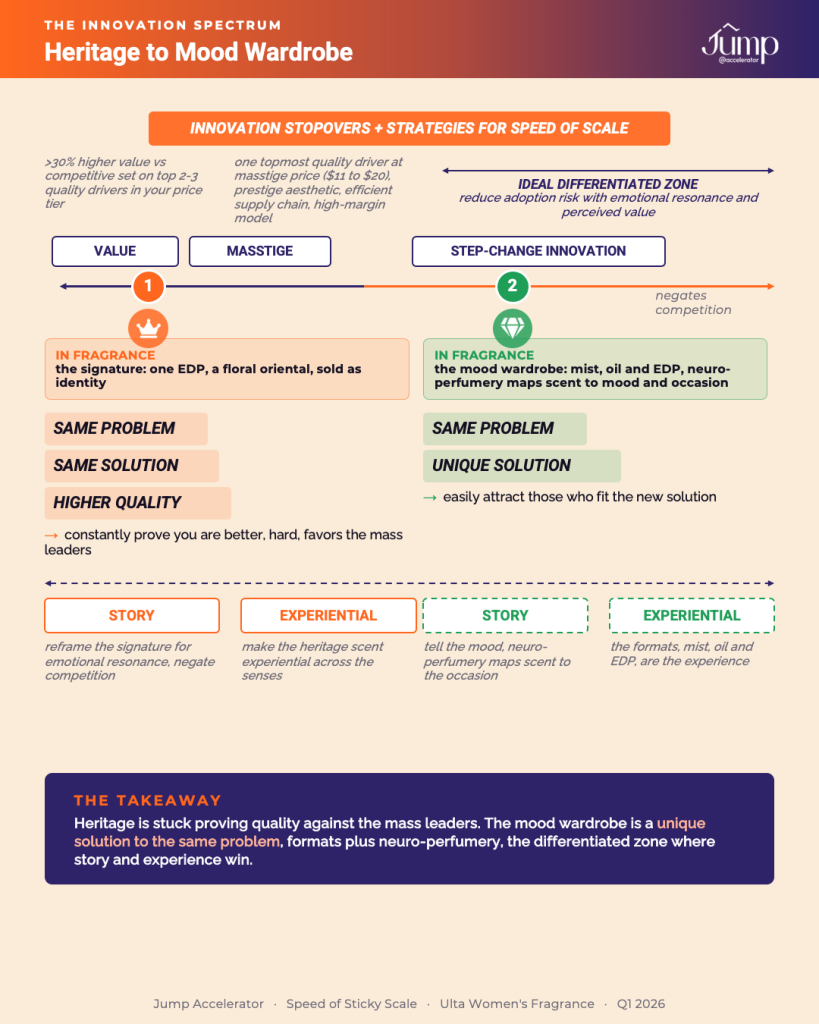
There are two ways to play, and only one negates the competition.
Heritage is the signature: one EDP, a floral oriental, sold as identity. It answers the same problem with the same solution at higher quality. That forces you to constantly prove you are better, which is hard and favors the mass leaders.
The mood wardrobe is the step-change: mist, oil, and EDP, with neuro-perfumery mapping scent to mood and occasion. Same problem, but a unique solution. You stop fighting on quality and start attracting the people who fit the new model, the differentiated zone where emotional resonance and perceived value cut adoption risk.
Heritage is stuck proving quality & reinforcing identity using advertising against the mass leaders. The mood wardrobe is a unique solution to the same problem, formats plus neuro-perfumery, the zone where story and experience win.
Why the mood wardrobe wins: neuro-perfumery and formats
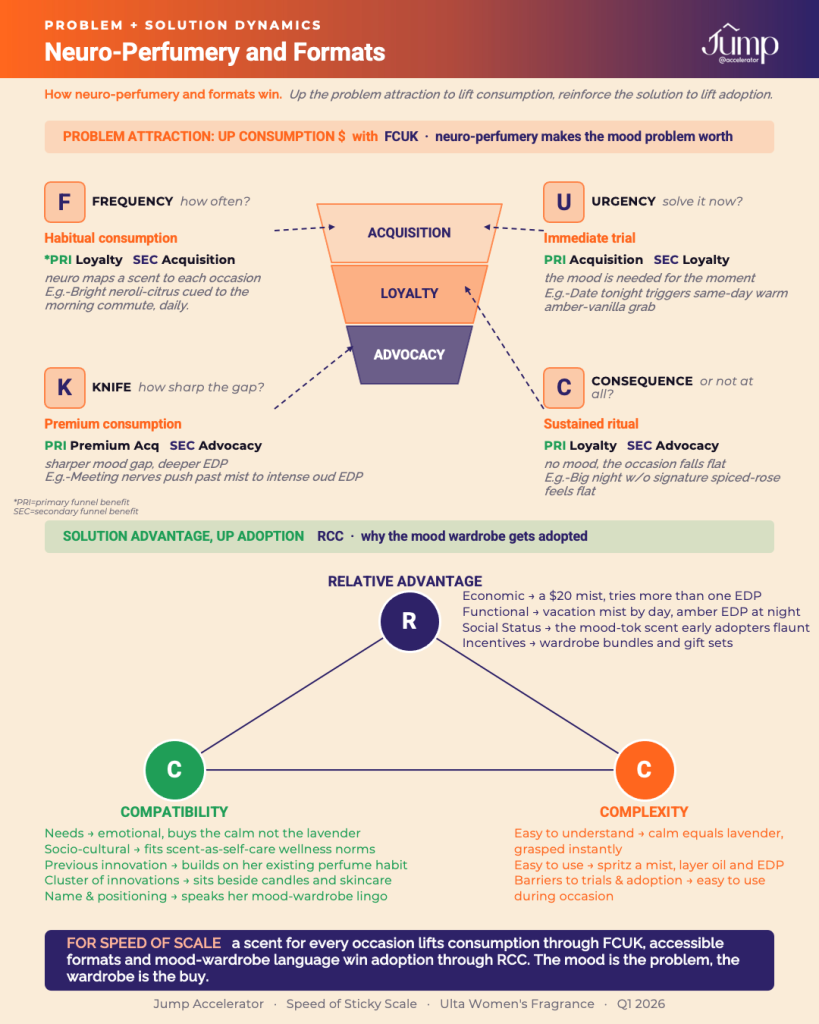
Two levers do the work. One lifts consumption($) via problem attractiveness, the other lifts adoption.
Lift consumption with FCUK. Neuro-perfumery makes the mood problem worth paying for.
- Frequency, how often: a scent mapped to each occasion turns into habitual consumption. Bright neroli-citrus cued to the morning commute, daily.
- Urgency, solve it now: the mood is needed for the moment. Date tonight triggers a same-day warm amber-vanilla grab.
- Knife, how sharp the gap: a sharper mood gap pushes premium consumption. Meeting nerves push past a mist to an intense oud EDP.
- Consequence, or not at all: no mood and the occasion falls flat. A big night without the signature spiced-rose feels off.
Lift adoption with RCC. This is why the mood wardrobe gets adopted, not just admired.
- Relative advantage: a $20 mist lets her try more than one EDP. Vacation mist by day, amber EDP at night. The mood-tok scent early adopters flaunt. Wardrobe bundles and gift sets.
- Compatibility: it fits how she already lives. She buys the calm, not the lavender. It sits beside her candles and skincare and speaks her mood-wardrobe language.
- Complexity: it is easy to grasp and easy to use. Calm equals lavender, understood instantly. Spritz a mist, layer oil and EDP, no learning curve.
The mood is the problem. The wardrobe is the buy.
Story plots for every occasion
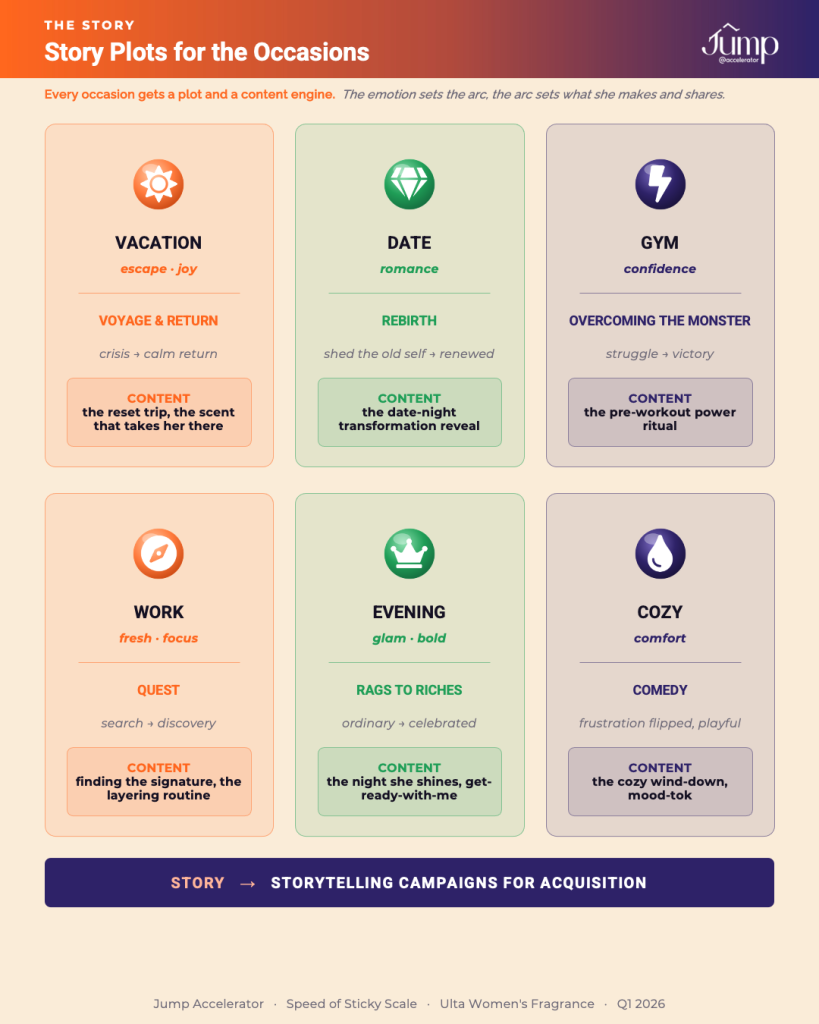
Every occasion gets a plot and a content engine. The emotion sets the arc, the arc sets what she makes and shares.
| Occasion | Emotion | Story plot | Content |
|---|---|---|---|
| Vacation | Escape, joy | Voyage and return | The reset trip, the scent that takes her there |
| Date | Romance | Rebirth | The date-night transformation reveal |
| Gym | Confidence | Overcoming the monster | The pre-workout power ritual |
| Work | Fresh, focus | Quest | Finding the signature, the layering routine |
| Evening | Glam, bold | Rags to riches | The night she shines, get-ready-with-me |
| Cozy | Comfort | Comedy | The cozy wind-down, mood-tok |
Story plot to be executed with campaigns for primarily driving execution and advocacy.
Conversation Catalysts: how mood becomes word of mouth
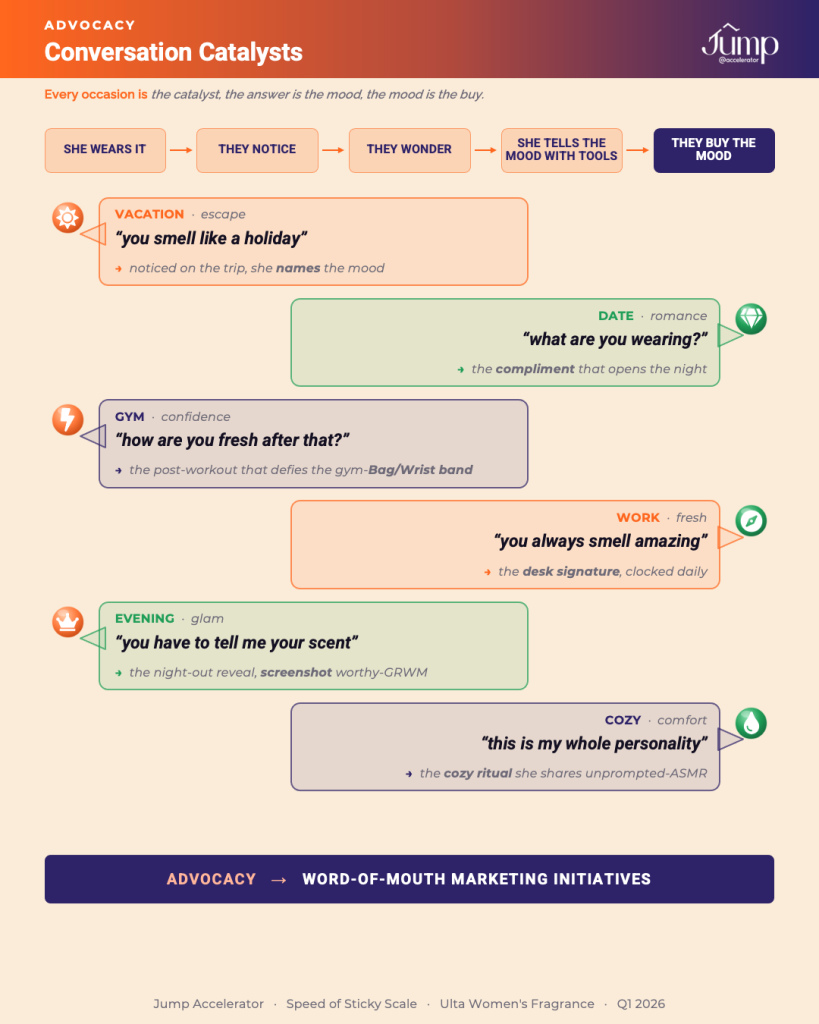
Advocacy has a path: she wears it, they notice, they wonder, she names the mood with the right tools, they buy the mood. Each occasion has a line that sets it off.
- Vacation, escape: “you smell like a holiday.” Noticed on the trip, she names the mood.
- Date, romance: “what are you wearing?” The compliment that opens the night.
- Gym, confidence: “how are you fresh after that?” The post-workout that defies the gym.
- Work, fresh: “you always smell amazing.” The desk signature, clocked daily.
- Evening, glam: “you have to tell me your scent.” The night-out reveal, screenshot-worthy.
- Cozy, comfort: “this is my whole personality.” The cozy ritual she shares unprompted.
Every catalyst becomes a word-of-mouth marketing initiative.
Winning the shelf: shopper marketing the emotional occasions in-store
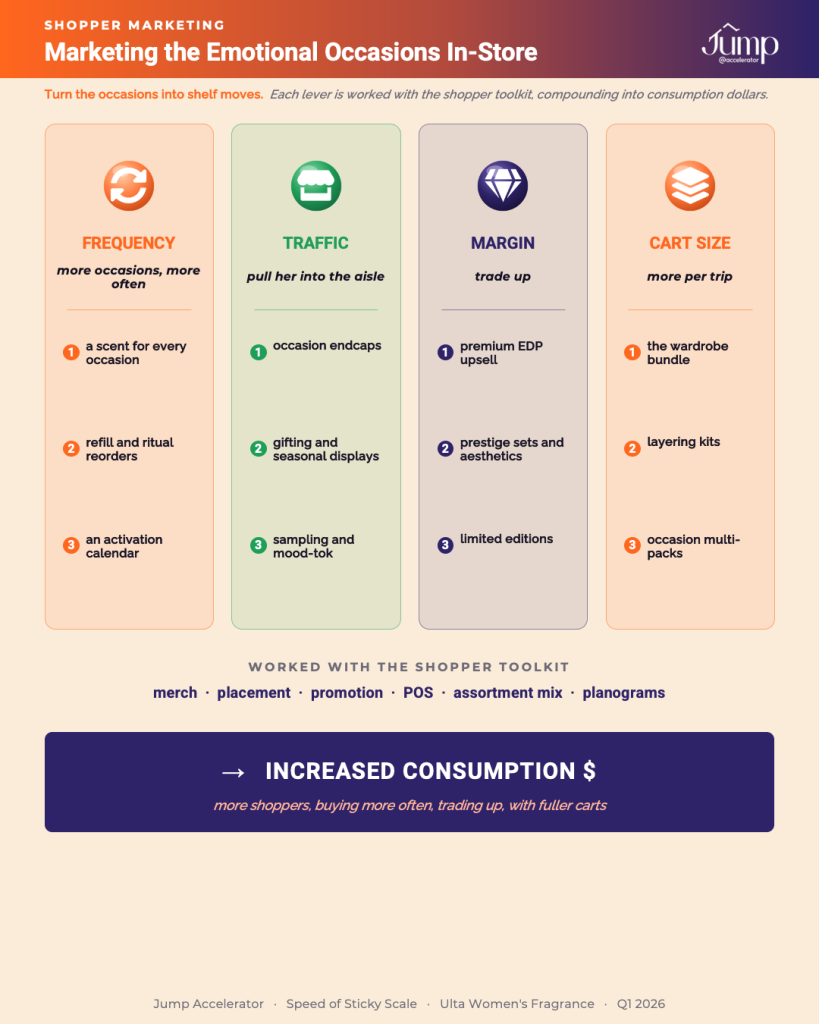
Turn the occasions into shelf moves. Four levers compound into consumption dollars, each worked with the full shopper toolkit: merch, placement, promotion, POS, assortment mix, planograms.
- Frequency, more occasions more often: a scent for every occasion, refill and ritual reorders, an activation calendar.
- Traffic, pull her into the aisle: occasion endcaps, gifting and seasonal displays, sampling and mood-tok.
- Margin, trade up: premium EDP upsell, prestige sets and aesthetics, limited editions.
- Cart size, more per trip: the wardrobe bundle, layering kits, occasion multi-packs.
The result is increased consumption dollars: more shoppers, buying more often, trading up, with fuller carts.
FAQs
What replaced the signature scent in 2026? The fragrance wardrobe, a rotating collection of scents chosen by mood, occasion, and time of day instead of one fixed bottle.
What is the difference between a fragrance wardrobe and scent stacking? A wardrobe rotates one format at a time across occasions for breadth. Stacking layers several formats at once into one scent for depth in a single moment.
What are the three fragrance formats in a mood wardrobe? Mist (the all-over base), oil or solid (close to the skin), and EDP (the projecting core).
Why is mood-based fragrance growing so fast? Mood ties scent to recurring needs and occasions, so one person buys many scents instead of one. That multiplies frequency, traffic, margin, and cart size.
What is neuro-perfumery? An emerging approach that maps specific scents to specific moods and occasions by design, using scent-to-mood research and AI-built accords.
SUMMARY
- The shift: Signature scent died, fragrance wardrobe took over.
- Mood in action: Emotion to story to conversation to buy.
- The thesis: Three formats, two behaviors, rotate or stack.
- The virtuous cycle: Mood kickstarts, lab restarts, story explodes it.
- The innovation spectrum: Heritage proves quality, wardrobe wins differently.
- Why it wins: FCUK lifts consumption, RCC lifts adoption.
- Story plots: Every occasion gets its own arc.
- Conversation catalysts: Each mood triggers word of mouth.
- Winning the shelf: Four levers- Frequency, Traffic, Margin, Cart size- compound into consumption dollars.
JUMP ACCELERATOR:
Speed of sticky scale fueled by decoded market intelligence| 70+ brands grown