Founders are stuck in a false choice, trying to scale their beauty brand.
Frame only Immediate results: you might not sound like every competitor, but you attract consumers who churn when the overnight miracle doesn’t arrive and lose the consumer who wants real transformation or lack the ability to deliver significant, immediate results.
Frame only Long-Term results: you sound credible, premium, aspirational and you never acquire at speed because you have no hook for the consumer who wants to feel something today.
Both cost founders scale.
The answer is not choosing between Immediate and Long-Term. The answer is owning the full arc: Immediate + Short-Term + Long-Term, with functional and emotional resonance applied at every stage.
Emotional promise: she lives and feels fully and tells others
A brand that frames all three stages acquires the instant-gratification consumer, retains the transformation-seeker and builds loyalty in everyone in between.
This is not a messaging exercise. It is a product, positioning and content strategy built on the full consequence arc.
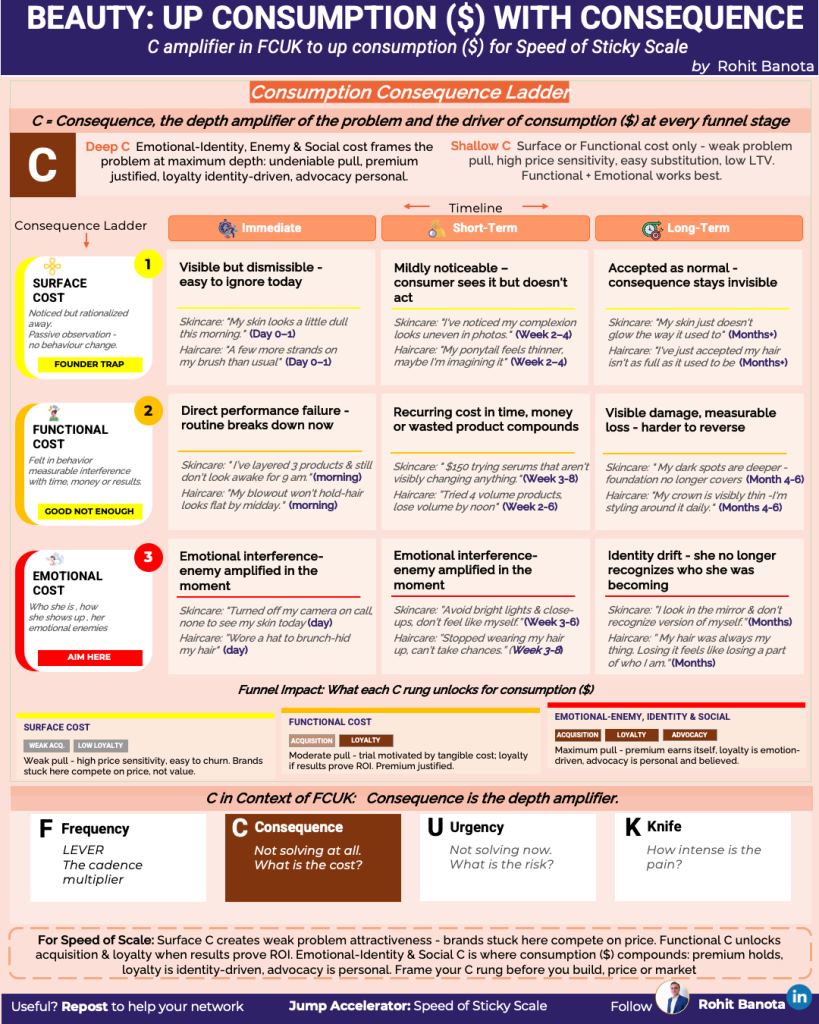
The Consequence Ladder: Three Rungs, Each With a Full Arc
Every rung of the Consequence Ladder has its own Immediate, Short-Term and Long-Term dimension.
Founders must map the pain at each rung across the full timeline. Then map the solution promise to match.
Rung 1: Surface Cost
Noticed. Rationalized away. No behaviour change.
Most competitors live here. It is the most crowded, lowest-margin, highest-CAC rung on the ladder. If you frame only Immediate Surface Cost, you are invisible in the noise.
Immediate
Skincare: “My skin looks a little dull this morning.” (Day 0-1)
Haircare: “A few more strands on my brush than usual.” (Day 0-1)
Makeup: “My foundation looks slightly off, a bit orangey.” (Day 0-2hrs)
Fragrance: “I can barely smell my perfume an hour after applying.” (Hour 1)
Short-Term
Skincare: “My complexion looks uneven in photos.” (Weeks 2-4)
Makeup: “My base never quite photographs the way it looks in my mirror.” (Weeks 1-3)
Fragrance: “I keep reapplying throughout the day, going through bottles fast.” (Weeks 1-3)
Long-Term
Skincare: “My skin just doesn’t glow the way it used to.” (Months+)
Haircare: “I’ve just accepted my hair isn’t as full as it used to be.” (Months+)
Makeup: “I’ve just accepted that my foundation will never be a perfect match.” (Months+)
Fragrance: “I’ve just accepted that fragrance doesn’t really last on my skin.” (Months+)
The danger: she adapts. The problem becomes invisible. So does your brand’s reason to exist. If your competitor is framing the same surface moment, you are both losing.
Rung 2: Functional Cost
Felt in behaviour. Time, money or results are measurably lost.
She can no longer rationalize it away. This is where brands that only marketed surface start to lose her as the problem never fully goes away or results don’t get better with time.
Immediate
Skincare: “I’ve layered three products and still don’t look awake for my 9am.” (Same morning)
The problem reshapes self-image, social confidence and belonging across all three timeline stages. No competitor marketing only Functional Cost is speaking to any of this. This rung is uncontested for most beauty categories.
Immediate
Skincare: “I turned off my camera on the call, I didn’t want anyone to see my skin today.” (Day of)
Haircare: “I wore a hat to brunch, I wasn’t ready for anyone to see my hair today.” (Day of)
Makeup: “I excused myself from dinner to redo my base in the bathroom, I felt embarrassed.” (Evening of)
Fragrance: “I leaned in to hug someone and wondered if they could tell my scent had completely gone.” (Day of)
Short-Term
Skincare: “I’ve started avoiding bright lighting and close-up photos, I don’t feel like myself.” (Weeks 3-6)
Haircare: “I’ve stopped wearing my hair up, it exposes what I don’t want people to notice.” (Weeks 3-8)
Makeup: “I’ve started declining after-work plans, I know my makeup won’t hold and I won’t feel confident.” (Weeks 2-5)
Fragrance: “My signature scent was how people remembered me, without it I feel generic, unfinished.” (Weeks 2-6)
Long-Term
Skincare: “I look in the mirror and don’t recognise the version of myself I’m becoming.” (Months+)
Haircare: “My hair was always my thing. Losing it feels like losing a part of who I am.” (Months+)
Makeup: “I used to love getting ready. Now it feels like a battle I can’t win, I’ve stopped trying as hard.” (Months+)
Fragrance: “Fragrance was the one luxury I allowed myself. Not finding one that works has quietly taken something from me.” (Months+)
She does not share because she was incentivised. She shares because it changed her across all three stages & rungs. You need both functional and emotional promise. That is loyalty & advocacy no paid acquisition budget can buy.
What this means for You
For Founders
Stop choosing between Immediate and Long-Term. That is a false choice built by brands that never understood the full arc.
Your job is to frame the full consequence arc, Immediate + Short-Term + Long-Term, with functional and emotional depth at every stage. That is what acquires, converts and retains across every consumer type in your category.
The founder who owns the full arc owns the category.
For Product Developers
The arc is your product brief:
Does the formula deliver a real Immediate result she can feel today?
Does it deliver a measurable Short-Term result she can track over weeks?
Does it deliver a Long-Term result visible enough to change how she sees herself?
If the product only delivers at one stage, the brand can only claim one stage. Consequence depth starts in the lab, not in the campaign.
For Marketers
Stop fighting competitors on Immediate claims only. That is over promising, expensive and loyalty-destroying battlefield.
Map your content calendar across all three rungs and all three timeline stages:
Immediate: hook the instant-gratification consumer with functional and emotional proof today
Short-Term: build credibility with the consumer who is tracking her progress
Long-Term: speak to the consumer who wants to know who she will become
At every stage, layer both functional and emotional promises. One without the other leaves half the consumer unmoved and half the funnel underfed.
For Investors
Ask one question: does this brand own the full consequence arc in its category?
Immediate only: high churn
Long-Term only: slow acquisition, low conversion, aspirational but not actionable
Full arc with functional and emotional depth: premium defensible, sticky loyalty, organic advocacy
Summary-The Founder Imperative
The Consequence Ladder is not a messaging tool first.
It is a product, positioning and content strategy diagnostic.
Ask at every stage:
What is the Immediate pain and promise, functional and emotional?
What is the Short-Term pain and promise, functional and emotional?
What is the Long-Term pain and promise, functional and emotional?
Answer all six. Build to all six. Communicate all six.
That is how you acquire the consumer who wants results today, retain the consumer who wants transformation and build a brand that neither of them wants to leave.
FAQs
Why is framing only Long-Term results a problem? Long-Term framing without an Immediate hook loses the consumer who needs a reason to start today. She wants to feel something now. Give her that first. Then show her where it leads.
How do you scale a beauty brand faster?Own the full consequence arc. Frame Immediate, Short-Term and Long-Term pain and promise, with functional and emotional resonance at each stage. That acquires the instant-gratification consumer, retains the transformation-seeker and builds loyalty across your entire category.
What is the Consequence Ladder? A proprietary diagnostic by Rohit Banota / Jump Accelerator. It maps the escalating cost of not solving a beauty problem: Surface Cost, Functional Cost, Emotional-Identity and Social Cost. Each rung has its own Immediate, Short-Term and Long-Term dimension. Together they form the full consequence arc that drives consumption ($) at every funnel stage.
What is the FCUK framework? Frequency, Consequence, Urgency, Knife. Four dimensions of problem attractiveness that determine how strongly a problem pulls a consumer toward a solution and how much consumption ($) a brand can drive at each funnel stage.
What does this mean for product development? The product must deliver at all three timeline stages. If it only delivers Immediate results, the brand can only credibly claim Immediate. Short-Term and Long-Term consequence start in the formula, not the campaign.