Shopping Cart
×
Growth engine most beauty brands ignore

Growth Engine Most Beauty Brands Ignore: Tribe Strategy

Tribe Strategy: Design for 6X Profitable Super Fans: Shorten & flip the funnel for speed of sticky scale.

Most beauty brands either try to acquire new consumers organically or spend everything on paid acquisition and wonder why growth feels slow or fragile respectively. Tribe strategy is the alternative – and it compounds.

Advocacy: How to design tribe strategy to reduce your acquisition cost

What is Tribe Strategy?

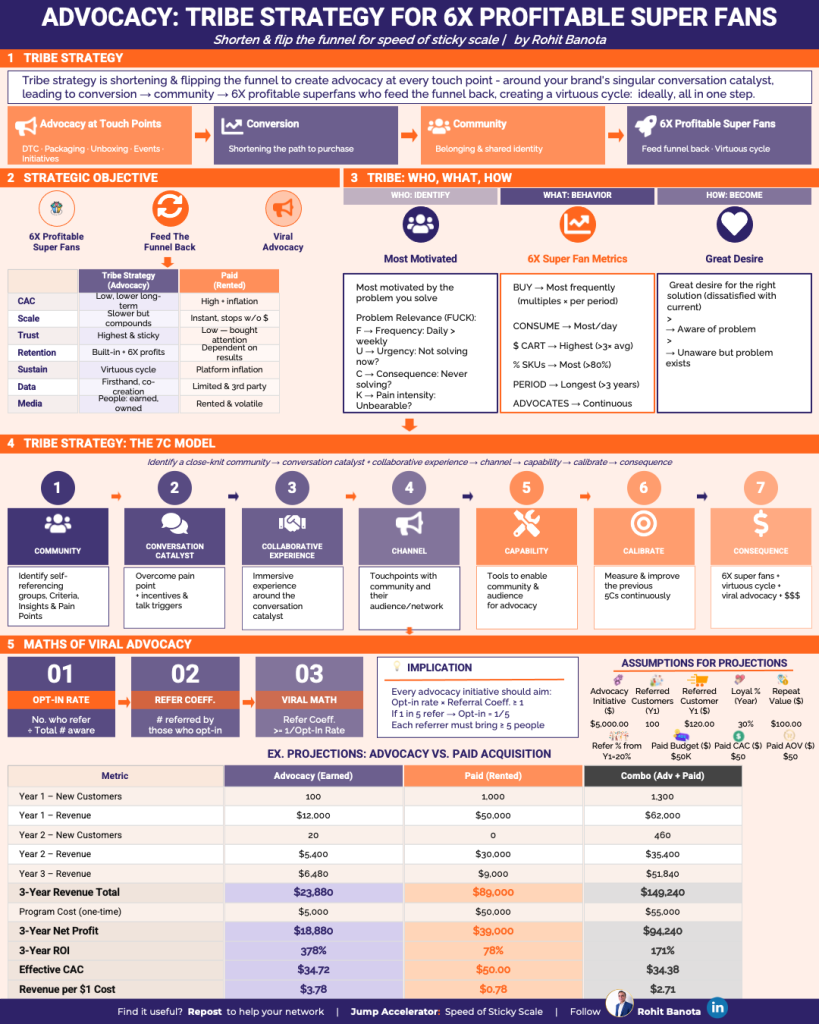
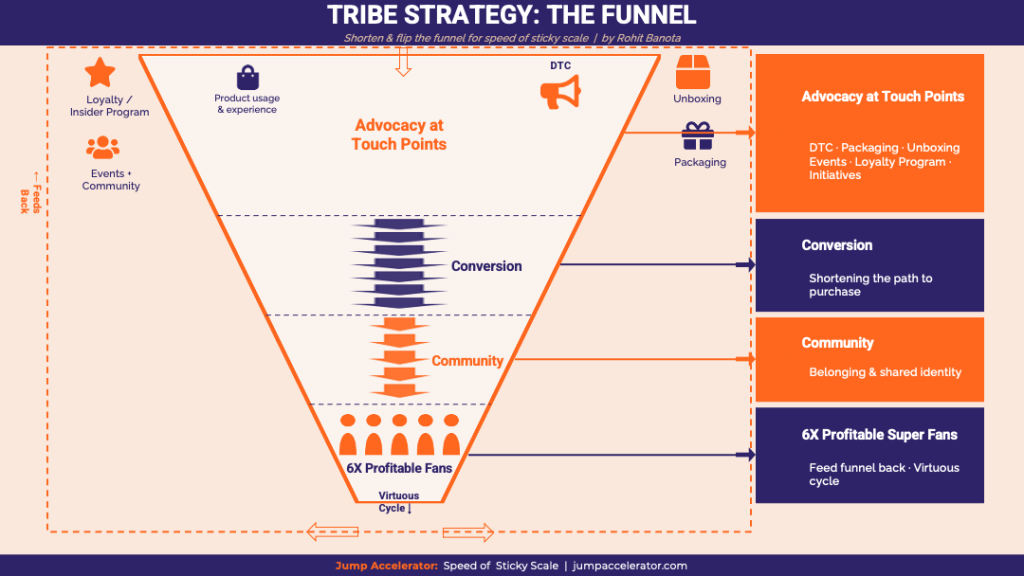
Tribe strategy is shortening and flipping the funnel to create advocacy at every touch point – around your brand’s singular conversation catalyst, leading to conversion, then community, then 6X profitable superfans who feed the funnel back, creating a virtuous cycle: ideally, all in one step.

advocacy, tribe strategy funnel for beauty brands

The flow looks like this:

Advocacy at Touch Points (DTC, packaging, unboxing, initiatives, emails) > Conversion (shortening the path to purchase) > Community (belonging and shared identity) > 6X Profitable Super Fans (who feed the funnel back)

The key shift: instead of paying for every new consumer, you build a system where your best consumers do the acquiring for you.

2. Strategic Objective - Tribe Vs. Paid in Beauty

The goal is three things working together: create 6X profitable super fans, feed the funnel back, and generate viral advocacy.

Here is why that matters more than paid acquisition:

 Tribe Strategy (Advocacy)Paid Acquisition (Rented)
CACLow, lower long-termHigh + inflation
ScaleSlower but compoundsInstant, stops without budget
Trust and ConversionHighest and stickyLow – bought attention
RetentionBuilt-in + 6X profitsDependent on results
SustainableVirtuous cyclePlatform inflation
DataFirsthand, co-creationLimited and 3rd party
MediaPeople: earned, ownedRented and volatile

Paid rents attention. Tribe earns it. The moment you stop paying, paid stops working. Tribe keeps compounding.

3. Your Tribe - Who, What, and How

Before you design anything, you need to know exactly who you are building for.

Who to identify – Most Motivated

Your tribe are the people most motivated by the problem you solve.

Use Problem Relevance (FCUK) to find them:

Frequency (how often do they face this problem – daily, weekly, monthly?),

Urgency (what is the impact of not solving it now?),

Consequence (what happens if they never solve it?), and

Knife (how intense is the pain – is it unbearable?). The higher the score across all four, the better the tribe candidate.

What behavior to look for – 6X Super Fan Metrics

You are looking for people who already buy

most frequently (multiple times per period),

consume most per day, have the highest cart size (3X the average),

purchase across the most SKUs (over 80%), stay the longest (over 3 years), and

advocate continuously – recommending to friends, family, and community both offline and online.

Potential super fans to influence – Great Desire

Super fans start with a great desire for the right solution because they are dissatisfied with what currently exists.

You want to leverage current advocates to influence potential super fans, who are desperately looking for a solution or are at least aware of the problem and feel the pain. 

4. The 7C Model - How to Design Tribe Strategy

Tribe strategy is not one tactic. It is a connected system of seven steps:

1. Community – Identify self-referencing groups. Find the people who already talk to each other about the problem you solve. Know their criteria for trust, their insights, and their pain points.

2. Conversation Catalyst – Create the one idea that overcomes their pain point and gives them a reason to talk. Add incentives and talk triggers so sharing feels natural, not forced.

3. Collaborative Experience – Build an immersive experience around the conversation catalyst. This is what deepens belonging and turns a consumer into a community member.

4. Channel – Choose the right touchpoints with the community and their audience. Meet them where they already are rather than asking them to come to you.

5. Capability – Give the community the tools they need to advocate to their own audience. Without capability, even motivated advocates go quiet.

6. Calibrate – Measure and improve the previous five Cs continuously. Tribe strategy is not set and forget. Track what is working and optimize the system.

7. Consequence – The result: 6X profitable super fans, a virtuous cycle, and viral advocacy that generates compounding returns.

5. The Maths of Viral Advocacy

Three numbers drive whether your tribe scales or stalls.

01 – Opt-In Rate: the number of people who refer divided by the total number of aware people.

02 – Referral Coefficient: the number of new people referred by each person who opts in.

03 – Viral Math: your referral coefficient needs to be greater than or equal to 1 divided by your opt-in rate.

The implication is simple: every advocacy initiative should aim for opt-in rate multiplied by referral coefficient to be greater than or equal to 1.

E.g., If 1 in 5 aware people refer (opt-in rate = 1/5), then each of those referrers must bring in at least 5 new people. Hit that number and the chain sustains itself.

The Projections - What This Looks Like in Real Numbers

MetricAdvocacy (Earned)Paid (Rented)Combo (Adv + Paid)
Year 1 New Customers1001,0001,300
Year 1 Revenue$12,000$50,000$62,000
Year 2 New Customers200460
Year 2 Revenue$5,400$30,000$35,400
Year 3 Revenue$6,480$9,000$51,840
3-Year Revenue Total$23,880$89,000$149,240
Program Cost$5,000$50,000$55,000
3-Year Net Profit$18,880$39,000$94,240
3-Year ROI378%78%171%
Effective CAC$34.72$50.00$34.38
Revenue per $1 spent$3.78$0.78$2.71

Assumptions: Advocacy initiative spend $5,000. 100 referred customers in Year 1 at $120 AOV. 30% annual loyalty rate. Repeat purchase value $100. Referral chain from Year 1 at 20%. Paid budget $50,000, paid CAC $60, paid AOV $50.

Paid wins on volume in Year 1. But Year 2 tells the real story – paid drops to zero new customers the moment the budget stops. Advocacy keeps generating. The combo column shows the biggest opportunity: a $5,000 tribe investment running alongside paid lifts 3-year net profit from $39,000 to $94,240 and cuts effective CAC to $34.38.

Summary

The best move for most early-stage beauty brands is not to choose one or the other and fire all growth engines together.

Start with tribe, add paid to accelerate, and let advocacy reduce your dependence on paid over time.


JUMP ACCELERATOR
Beauty reports & solutions for speed of sticky scale| 70+ brands grown

Leave a Comment

Your email address will not be published. Required fields are marked *

Layer 1